Saturday, 1 March 2014

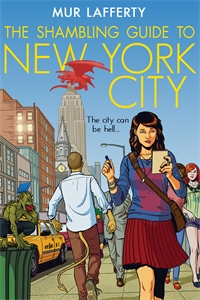
The Shambling Guide to New York City by Mur Lafferty

THE SHAMBLING GUIDE TO NEW YORK CITYI already had this on my TBR list when I was lucky enough to win a copy on a Goodreads giveaway. Urban fantasy is a relatively new genre for me, but it's fast becoming one of my favourites.

Zoe Norris is forced to return to her home town of New York after the break-up of a bad relationship. She is a book editor, so when she sees an advert for a job editing a travel guide to the city, she applies. It transpires that this will be a guide for the supernatural and paranormal denizens (known as the coterie) of New York, creatures who up until this point Zoe hadn't known existed. She will be the only human working on a staff which includes vampires, zombies, and a death goddess. Not all her colleagues welcome her presence.

The balance between humans and the coterie is carefully preserved. Most humans are blithely unaware of the coterie, and the coterie are monitored and controlled by an organisation called Public Works. But now it seems as though someone is deliberately sabotaging this balance, which could have catastrophic consequences.

This is the first in an intended series of Shambling Guides and as such there was quite a lot of explanation to get through establishing the world in which Zoe finds herself. I thought this was done in a very light and easy way - I didn't feel like I was just having a load of exposition dumped on me. It's a humorous, fun book. Between each chapter is an extract from the guidebook Zoe is editing; for example this on mid-town architecture,

While the humans will be checking out the Apple Store for expensive computers and gadgets, we encourage any visiting coterie to stop and admire its all glass structure. It is actually crystal, and was built by a race  of apini demons native to the southern US.

If you enjoy Ben Aaronovitch's Peter Grant books I'm sure you will enjoy this. I'm certainly going to look out for more books by Mur Lafferty, and I'm looking forward to the next in this series.

Saturday, 22 February 2014

One Night in Winter by Simon Sebag Montefiore


I have enjoyed Simon Sebag Montefiore's TV series, most recently the one on the history of Byzantium, but I have never read any of his books. So I was delighted to receive this one from the publisher and curious to find out if I would enjoy it.


It opens in the final months of the Second World War with the shooting of two teenage friends in Moscow. However, as one of the investigating policemen says, 'These aren't just any dead children.'  Their parents are high up in government, as are the parents of their friends. They belonged to a secret club called The Fatal Romantics Club, seeming innocent and childish, but suddenly under the glare of the investigation it becomes much more. The inquiry into the deaths becomes like a sinkhole opening up in the lives of everyone who knew this boy and girl. It gets bigger and bigger and more and more people are drawn in - friends, siblings, parents, teachers.

I thought that this book was so good at evoking the poisonous atmosphere of Stalinist Russia. It's not something I know much about, I recognised very few of the real life characters in it. Being close to Stalin was no guarantee of safety. He was so unstable and capricious that you could be his favourite one day and arrested the next. No-one could reveal the slightest suggestion of doubt in his leadership. No-one could be trusted, not even your own family. There was always someone prepared to betray, either through ambition, or fear, or because they genuinely believed in communism. I actually found some parts of it quite distressing to read.

In the afterword Simon Sebag Montefiore writes, "This is not a novel about power but about private life - above all, love." I much preferred the parts of the story about the politics to the parts about the love affairs. The horror of being caught in the web around Stalin with no way to escape, and no choice but to play the game to survive was so powerfully rendered. I also found the descriptions of how the mothers felt when their children were being arrested very powerful and moving. They were so terrified and so helpless.

I really enjoyed this, it's a proper page-turner and kept me gripped to the end. I will definitely read more by Simon Sebag Montefiore.

Sunday, 2 February 2014

Havisham by Ronald Frame

HavishamMiss Havisham is one of the most fascinating characters in literature. Devious, manipulative, perhaps
mad. A dreadful thing happened to her, but dreadful things do happen to people and for the most part they soldier on. Why was Miss Havisham so completely devastated that she chooses not to engage with the world, but to exist in a twilight state, in a moment frozen in time? This novel attempts to show how she came to be sitting in an ancient wedding dress, next to a mouldering wedding feast, loving no-one and no-one loving her.

Ronald Frame shows Catherine Havisham as the indulged only child of a successful brewer. Her mother died when Catherine was born and her father is busy with the business. Catherine is left a lot of the time to her own devices.

My father must have supposed that no other child could have had a happier time of it than I did. He showered me with gifts, which he didn't consider treats but things I had a perfect right to enjoy. But even amplitude and generosity pall. When I was by myself, I had a finite amount of imagination to help me play; when another child was brought along, I became possessive, only because I was afraid of having to reveal my embarrassment at owning so much.

Her father wants her to move up in the world and educates her as such. She is outwardly worldly, but because of her secluded childhood has very little understanding of other people's feelings and motives.

There are tragic hints of what is to come; as a young woman she acts in tableaus, staged scenes just as her wedding day becomes like a stage set. When she meets Compeyson I was hoping against hope that this time it would turn out differently! But of course it didn't.

The story is narrated by Miss Havisham at the end of her life. She is quite honest with herself, though perhaps not quite so honest to Pip or Estella. Jaggers the lawyer is the only one with whom she seems to be able to let down her guard. It is a tragic story, she wasn't a bad person but there was nobody in her whole life who she could trust (actually that's not quite true but she didn't recognise the worth of that person). Her pampered life and her lack of imagination didn't allow her to expect that her life would be anything other than gilded and glowing. When it didn't turn out that way she didn't have the resources to deal with it.

Saturday, 25 January 2014

The Quincunx by Charles Palliser

jacket image for The Quincunx by Charles Palliser - large versionThis was the final one of my chosen rereads for 2013, though it did slip over into 2014. A chunky, labyrinthine Victorian pastiche it is perfect for reading on cold winter nights. It's a book you have to throw yourself into wholeheartedly, if you just read a couple of pages at a time it would be very difficult to follow the story. And it would probably take you the rest of your life to finish it. I thought I didn't remember any of it, but as I got into it I realised that it was coming back to me.

The story concerns John Huffam who at the beginning of the novel is a young boy living with his mother in an English village. They are not wealthy, but live comfortably. However John is aware that his mother has secrets. She is very protective of him and he is allowed very little freedom. They don't seem to have any friends and strangers to their door are treated with suspicion and even fear.

The death of a relative John has never even met sets off a train of events which will radically alter John's life. This relative was paying John's mother an allowance and without it seems that they will sink  inexorably into poverty. In early Victorian times of course this was a terrifying prospect, as it probably meant the workhouse, or death. During this time John discovers his mother's secret; a document which is in his mother's possession which could prove vital in establishing the heir  to a disputed fortune. John could be the heir, but so could other people, some of whom are extremely ruthless.

John is thrust into a life for which he is ill-prepared. He has to live by his wits and doesn't know who to trust. Sometimes it is pure luck that keeps him alive. It seems that his life is to be a tragedy. But somehow he keeps going, determined to live.

At almost 1,200 pages it is a book that I find impossible to summarise. But if you've got the time to set aside for it, I would recommend it as an engrossing story.

Sunday, 19 January 2014

Flappers: Six Women of a Dangerous Generation by Judith Mackrell

Flappers: Women of a Dangerous Generation
I was looking forward to reading this book from the moment I heard about it. I'm really attracted by this period in history, and I love biographies. My reading about and from the early twentieth century has expanded greatly since joining the Bright Young Things group on Goodreads last year, and I think that group may be where I first heard about this book.

The six women Judith Mackrell writes about are: Diana Cooper, Nancy Cunard, Tallulah Bankhead, Zelda Fitzgerald, Josephine Baker and Tamara de Lempicka. I'd heard of all of them but didn't know a great deal about any of them. What they have in common is that they were young women in the 1920s, a time of social upheaval and years in which women were becoming more independent. Of course their lives weren't representative of most women's lives at the time. Most women probably lived lives which weren't very different from the lives of their mothers and grandmothers. But these six, and others like them became famous and young women of the time aspired to be like them. Even if working class women still didn't have many opportunities they could now have aspirations and role models. Tallulah Bankhead in particular had fanatical young women admirers who queued for hours to see her performances.

With the exception of Josephine Baker, all these women came from wealthy backgrounds, though in the case of Tamara de Limpicka she lost everything when she was forced to flee Russia during the Revolution. I particularly admired Tamara. She had led a pampered life in Russia and the change to a life of relative poverty in Paris must've been a tremendous shock. Her husband (and many others) did not have her ability to create a new life.

It was a mystery to Tamara how her confident playboy of a husband could become so unattractively mired in depression.......It was one reason why, when Tamara found the resolve to turn her life around she did so entirely on her own terms and without bothering to consult Tadeusz. Once she had decided to become a professional painter she immersed herself completely in the project, certain that from now on her own ambitions would take precedence over his.

One of things that is made very clear in this book is how hard it is to be a trailblazer. All of these women had ambitions which were way ahead of what society was prepared to accept. Alcohol and drugs feature heavily in a number of these stores, a comfort in lives which were often unhappy. The most successful professionally was Josephine Baker, a woman who came from almost unimaginable hardship to become an international superstar whose fame endures long after her death. She never achieved the stable personal life she craved. In comparison Diana Cooper did have a stable home life, but at the cost of giving up a promising career in the theatre.

I loved this book, just as I loved Judith Mackrell's book about the Russian ballerina Lydia Lopokova. These were exceptional women and they lived in fascinating times.

Saturday, 28 September 2013

Bowes Museum

Last Sunday we went to Bowes Museum, near Barnard Castle in County Durham. It has been one of my favourite places since I went there on a school trip as a child. The building is fabulous - a French chateau dropped into the beautiful countryside of Teesdale. It was established by John and Josephine Bowes as a purpose built museum to house their extensive collection of art and artifacts. It was first opened to the public in 1892.

The most famous piece, and the emblem of the museum is the Silver Swan, a clockwork automoton dating from 1773. John and Josephine first saw it at the Paris International Exhibition in 1867. Another fan of the swan, who saw it at the same exhibition, was Mark Twain. He wrote in The Innocents Abroad;
'I watched the Silver Swan, which had a living grace about his movement and a living intelligence in his eyes - watched him swimming about as comfortably and unconcernedly as it he had been born in a morass instead of a jeweller’s shop - watched him seize a silver fish from under the water and hold up his head and go through the customary and elaborate motions of swallowing it...'
We saw that exact same thing last Sunday, almost 150 years after Mark Twain did. The sophisticated 21st century audience still gave a round of applause when the swan swallowed the fish!

There is lots to see in the museum, but we had gone specifically to see two temporary exhibitions; Henry Poole & Co. Founder of Savile Row: The Art of Bespoke Tailoring and Wool Cloth, and Laura Ashley, Romantic Heroine.

Henry Poole & Co. was opened in 1806 and established Savile Row as the centre for bespoke tailoring in London.
Their customers included Winston Churchill, Charles Dickens and Edward VII. They have their customer ledgers from 1846, and some of them were on view, open at the pages of their famous clients. When Edward VII was Prince of Wales he asked Henry Poole & Co. to cut a short, blue evening coat for him. This garment is said to be the original dinner jacket (tuxedo in the US).
They hold Royal Warrants still, including the Royal Warrant for the Queen's State Livery.  The exhibition showed various styles of suits, and also explained the process of making a bespoke garment. There were fabric sample books available so we could feel the wonderful quality of the material used in these garments.

The Laura Ashley exhibition showed, in the company's 60th year, almost 100 examples of Laura Ashley dresses from the 60s and 70s.
There was very little about the company or Laura Ashley herself, the focus was entirely on the frocks. I absolutely loved the way this exhibition was staged. The dresses were packed together in two blocks, and the information about them was at floor level so there was no obstruction to viewing them. It was very simple and effective. What amazed me about the dresses was how much they harked back to earlier centuries. Some of them looked Regency, others looked like something Laura Ingalls would've worn on the prairie. Many of
them looked quite restrictive with high collars and tight sleeves. I was puzzled as to why, after women's fashion had become so much more free in the 60s, women would choose these styles again. I wouldn't particularly want to wear most of the dresses, but I did like the prints.

It had been 5 or 6 years since I last visited the Bowes Museum and I certainly won't be leaving it that long again. It's the kind of place where there is always something new to see, and things that have been there all the time that you never noticed before.

Saturday, 21 September 2013

The Murder Wall by Mari Hannah

The main character in this book is Kate Daniels, a Detective Chief Inspector with Northumbria Police.
A man is found murdered in an expensive flat in Newcastle, and the case becomes the first one in which Kate is Senior Investigating Officer. She is more than ready for the challenge, but she is also haunted by an unsolved murder earlier in the year. It affected her quite personally and she can't let go of it. It is very important to her to solve this new case, it seems like she has something to prove to herself.

Things get off to a bad start when she recognises the dead man. She should immediately disclose this fact, but she doesn't. It's a split second decision she makes to protect someone she cares about. It's a decision she regrets but events move quickly and there doesn't seem any way back from it. She sees connections between this murder and the unsolved one - but is she just seeing what she wants to see? Kate Daniels is a very capable police officer but her personal feelings are pulling her off course.

This is the first book in a series and as such there are a lot of characters to meet and get to know. I didn't feel out of my depth reading it though, I wasn't overloaded with information which I sometimes find happens with police procedurals (the fault of my concentration - not the genre). Kate Daniels is a very appealing character and I liked her. I liked that she is good at her job, and respected by her colleagues. We get to see some of her personal life, and it's going through a bit of messy phase, as most people's lives do at some point. But it's not so messy that the reader is left wondering how on earth she manages to hold down a responsible job.

Another thing I really liked about it is how Mari Hannah portrays the North East. I think that often it is portrayed as a hard, gritty place, but there is so much more to it. I particularly liked this bit;

The air was fresh as she ran down her street and out on to the main road, turning left a few minutes later, skirting the edge of Jesmond Dene, a Victorian park covering actres of woodland, presented to the city in the late nineteenth century by local philanthropist, Lord Armstrong. Had it been daylight she would've taken in the beauty of this hidden gem: the network of paths and bridges, the waterfall, the mill, all enclosed within a deep narrow valley. The fabulous scenery drew locals and tourists in droves - five minutes and yet a world away from a thriving party city.

The next in the series is Settled Blood and I look forward to reading it and learning more about Kate Daniels and her colleagues.