This novel is a snapshot of London around the time of the financial meltdown. The characters are all connected by the fact they live and work in Pepys Road, a Victorian residential street. Pepys Road has seen many social changes over the years, and in 2007 it was a desirable place to live, and you would have to be wealthy to buy there. Wealthy like Roger and Arabella, but Roger, a banker, desperately needs his bonus to be a big one to keep the the lifestyle they aspire to. When it isn't, things start to unravel. Petunia has lived in her house on Pepys Road all her life (apart from when she was evacuated during the War). Her daughter has moved out of London and Petunia's health is failing. Zbigniew is a builder from Poland who often works for residents of Pepys Road as they endlessly remodel their houses. He doesn't intend to remain in London, but to earn enough money to return to Poland and set up a business with his father. There are other characters, all of whose lives bring them into contact with Pepys Road.
Postcards start arriving at every house on the road, postcard which read 'We Want What You've Got'. At first residents assume that it is advertising from an estate agent, but the postcards keep coming and gradually become more sinister.
A snapshot of life in London is the best way to describe this book All the characters have their own stories going in, stories which don't have anything to do with the other characters. Lanchester uses them to examine the issues which many people are concerned about; the integrity of our financial systems, immigration, the fear of terrorism. He does it in a fantastically easy to read way. I enjoyed it and look forward to reading more by him.
Saturday, 10 January 2015


Thursday, 1 January 2015
Books for 2015
Every year I choose six books to re-read, and twelve books from my TBR shelves to read over the coming year. This year the choices are:
Re-reads
Bleak House by Charles Dickens
Wicked by Gregory Maguire
Manly Pursuits by Ann Harries
Carter Beats the Devil by Glen David Gold
Air and Fire by Rupert Thomson
TBR shelf reads
The Stockholm Octavo by Karen Engelmann
Cinema Lumiere by Hattie Holden Edmonds
The Ninth Daughter by Barbara Hamilton
The Great Fortune by Olivia Manning
White Corridor by Christopher Fowler
Our Spoons Came From Woolworths by Barbara Comyns
The Amazing Adventures of Kavalier & Clay by Michael Chabon
The Woman Who Walked Into Doors by Roddy Doyle
The American Boy by Andrew Taylor
Settled Blood by Mari Hannah
The Convictions of John Delahunt by Andrew Hughes
The Real Jane Austen by Paula Byrne
I am determined to be a more conscientious blogger in 2015 - I was horrified to realise that I haven't blogged since March. It's been a busy year! I haven't been very good about reading other people's blogs either, and I've missed it. So I'll make time for both things.
Saturday, 22 March 2014
Reading for Spring

Clockwork Angel by Cassandra Clare
Described an 'urban fantasy full of vampires, werewolves and shape-shifters' it is set in London in 1878. It's the first book in The Infernal Devices series.
A Madness of Angels by Kate Griffin
This is another first book in a series (the Matthew Swift novels) and is again set in London. 'Enter a London where magicians ride the Last Train, implore favours of the Beggar King and interpret the insane wisdom of The Bag Lady'.
Broken Homes by Ben Aaronovitch
This is more of a known quantity because it is the fourth in the series and I loved the other three. A police procedural, the hero is PC Peter Grant an apprentice wizard who works for the Metropolitan Police. (London again, I didn't realise how London-centric the list was until I've started typing it out).
Any Other Name by Emma Newman
The second in the Split Worlds trilogy. I've actually had this on my shelf for ages, but I was waiting for Once Upon a Time to read it. The blurb says 'It's Downton Abbey with magic, in Bath's secret mirror city'. That sounds impossible to resist.
Jonathan Strange and Mr Norrell by Susanna Clarke
This is a re-read. I loved it when I previously read it and am hoping it's as good as I remember.
That's my list, and I'm looking forward to getting started.
Saturday, 15 March 2014
Wedlock by Wendy Moore

Andrew Robinson Stoney was an Irish soldier. He was handsome, charming, and extremely manipulative. He had already been married and the gossip was that he had driven his first wife to her grave by his ill-treatment. Unbelievably he tricked Mary Eleanor into marrying him by pretending that he was dying. Once they were wed he made a miraculous recovery. Mary Eleanor's life from then until the end of her marriage was a living hell.
After her marriage she no longer had any rights over her own money and Stoney kept her almost penniless. He was physically and emotionally abusive. He kept her from seeing her mother and her friends, she was often a prisoner in her own home. She was rarely given enough to eat and became thin and gaunt. She was a clever woman and had a keen interest in botany and science but Stoney prevented her from pursuing those interests.
This is all shocking enough, but what amazed me the most was that there seemed to be nothing she could do to save herself. Plenty of people knew what was going on but nobody stepped in to help her. Stoney was a master of disinformation and he let it be known that Mary Eleanor was irrational - almost deranged - and people believed him. When help finally did come it wasn't from anyone in her own social class, but her servants who rescued her. Those with the most to lose risked everything, while those with the power stood and watched.
I thought this was a fascinating and horrifying book. Domestic abuse still happens today of course, and women still stay with abusive men, through fear, or being so beaten down that they can't see a way out. But at least it's a subject that's talked about, and there are laws to protect women, and refuges for them to go to. Mary Eleanor had none of that. Though she attained a measure of peace in her later years, because of Andrew Stoney Robinson the happy life she could've had and the good she could've done in the world through her patronage of scientific endeavours never happened.
(Incidentally, Mary Eleanor's grandson John and his wife Josephine founded the Bowes Museum, which I wrote about here.)
Saturday, 8 March 2014
Running Like a Girl by Alexandra Heminsley
 Running is something that I liked as a child. I am one of that strange breed who actually enjoyed cross-country at school. But running (in fact all sport) stopped when I left school. I can't say that I've particularly missed it. On the other hand I am quite often tired these days and have got significantly heavier over the past few years. Lack of exercise has got a lot to do with that. My son joined our local running club a couple of years ago and that stirred in me some long-forgotten urge to run. But only enough to make a couple of half-hearted attempts and then give up. Then I heard about this book and ordered it from the library. I started it straightaway and finished it in about two days.
Alexandra Heminsley is a journalist who hadn't done any sport for years and didn't think of herself as an athletic person at all. But she decided that she wanted to run.
That was it, I was going to run round the block. I had high hopes: hopes of the arse of an athlete, the waist of a supermodel and the speed of a gazelle. Defeated by gyms, bored by sanctimonious yoga teachers and intimidated by glossy tennis clubs, I decided it was time to end a lifetime spent believing myself to exist on the outside of sport. I would return powerful and proud, the city still reeling at the sight of my grace and speed on the pavements of Kilburn.
Suffice to say it didn't turn out as she planned. But she didn't give up and by sheer tenacity and perseverance turned herself into a runner.
It's very funny, there's plenty of stuff like the paragraph quoted above. She doesn't mind laughing at herself (she fell down while trying to high-five spectators at her first marathon), and she is honest about her setbacks as well as her successes. It is also quite moving, she writes about how running helped her reconnect with her father with whom she'd had a loving, but quite distant relationship. He had been a keen runner and it gave them a shared interest and something to talk about.
There's lots of practical advice as well; about kit, injuries, what to take to a race. All in all I think it's an ideal book for women who think they might like to run. I found it very inspiring and am running again. Very slowly, and not in daylight - but it's a start.
Saturday, 1 March 2014
The Shambling Guide to New York City by Mur Lafferty
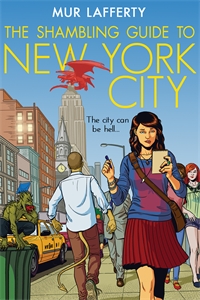 I already had this on my TBR list when I was lucky enough to win a copy on a Goodreads giveaway. Urban fantasy is a relatively new genre for me, but it's fast becoming one of my favourites.
Zoe Norris is forced to return to her home town of New York after the break-up of a bad relationship. She is a book editor, so when she sees an advert for a job editing a travel guide to the city, she applies. It transpires that this will be a guide for the supernatural and paranormal denizens (known as the coterie) of New York, creatures who up until this point Zoe hadn't known existed. She will be the only human working on a staff which includes vampires, zombies, and a death goddess. Not all her colleagues welcome her presence.
The balance between humans and the coterie is carefully preserved. Most humans are blithely unaware of the coterie, and the coterie are monitored and controlled by an organisation called Public Works. But now it seems as though someone is deliberately sabotaging this balance, which could have catastrophic consequences.
This is the first in an intended series of Shambling Guides and as such there was quite a lot of explanation to get through establishing the world in which Zoe finds herself. I thought this was done in a very light and easy way - I didn't feel like I was just having a load of exposition dumped on me. It's a humorous, fun book. Between each chapter is an extract from the guidebook Zoe is editing; for example this on mid-town architecture,
While the humans will be checking out the Apple Store for expensive computers and gadgets, we encourage any visiting coterie to stop and admire its all glass structure. It is actually crystal, and was built by a race of apini demons native to the southern US.
If you enjoy Ben Aaronovitch's Peter Grant books I'm sure you will enjoy this. I'm certainly going to look out for more books by Mur Lafferty, and I'm looking forward to the next in this series.
Saturday, 22 February 2014
One Night in Winter by Simon Sebag Montefiore
I have enjoyed Simon Sebag Montefiore's TV series, most recently the one on the history of Byzantium, but I have never read any of his books. So I was delighted to receive this one from the publisher and curious to find out if I would enjoy it.

It opens in the final months of the Second World War with the shooting of two teenage friends in Moscow. However, as one of the investigating policemen says, 'These aren't just any dead children.' Their parents are high up in government, as are the parents of their friends. They belonged to a secret club called The Fatal Romantics Club, seeming innocent and childish, but suddenly under the glare of the investigation it becomes much more. The inquiry into the deaths becomes like a sinkhole opening up in the lives of everyone who knew this boy and girl. It gets bigger and bigger and more and more people are drawn in - friends, siblings, parents, teachers.
I thought that this book was so good at evoking the poisonous atmosphere of Stalinist Russia. It's not something I know much about, I recognised very few of the real life characters in it. Being close to Stalin was no guarantee of safety. He was so unstable and capricious that you could be his favourite one day and arrested the next. No-one could reveal the slightest suggestion of doubt in his leadership. No-one could be trusted, not even your own family. There was always someone prepared to betray, either through ambition, or fear, or because they genuinely believed in communism. I actually found some parts of it quite distressing to read.
In the afterword Simon Sebag Montefiore writes, "This is not a novel about power but about private life - above all, love." I much preferred the parts of the story about the politics to the parts about the love affairs. The horror of being caught in the web around Stalin with no way to escape, and no choice but to play the game to survive was so powerfully rendered. I also found the descriptions of how the mothers felt when their children were being arrested very powerful and moving. They were so terrified and so helpless.
I really enjoyed this, it's a proper page-turner and kept me gripped to the end. I will definitely read more by Simon Sebag Montefiore.
Subscribe to:
Posts (Atom)